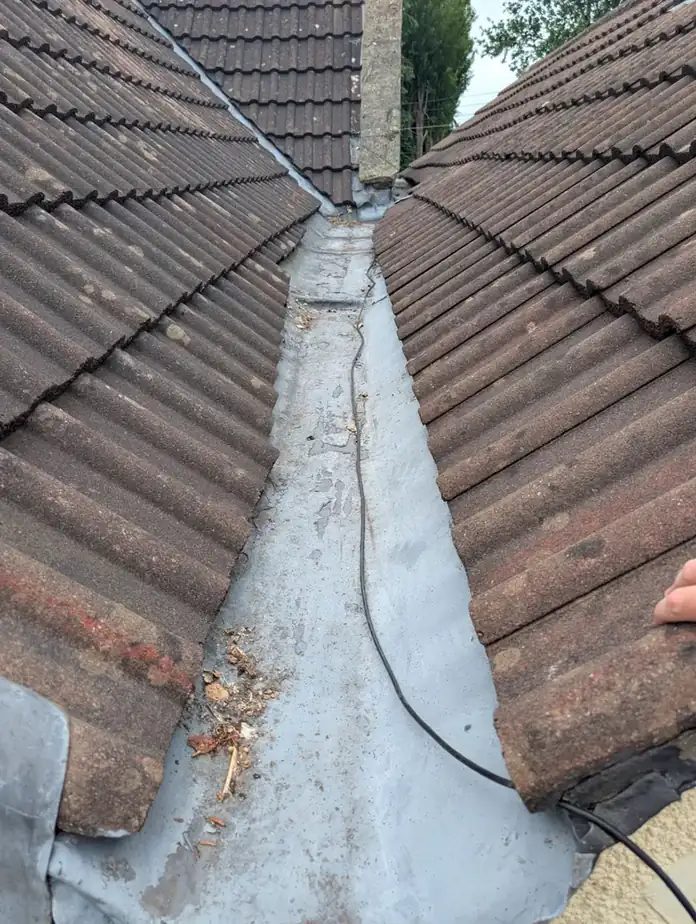
Lead Flashing & Valley Repairs In Newcastle
Has somebody already been up and smeared sealant over the lead, and it is still leaking?
Step flashings, soakers, back gutters, aprons and lead or GRP valleys repaired and renewed on roofs across Newcastle upon Tyne and Tyne and Wear
Lead is where a roof changes direction or meets something else: a chimney, a wall, another slope. It is also where most of the water on the roof ends up. When it splits, lifts or gets nicked by a scrap merchant, the leak is usually fast and obvious. We re-dress lead that can be saved and replace lead that cannot, in the right code for the job, fixed the way it is supposed to be fixed. No mastic, no bitumen paint. Free inspection, written price.
- Code 4 for flashings and soakers, Code 5 for valleys, as standard
- Lead let into raked joints and wedged, never stuck on the surface
- Valleys cleared, inspected and photographed before we quote
- Written guarantee on all leadwork
Get A Free Roof Inspection
Tell us what is going on and we will ring you back to arrange a look.
Where Lead Lets Go On Tyneside Roofs
Lead lasts a very long time when it is the right thickness and fitted so it can move. Most of the lead we replace fails one of those two tests.
Fatigue Cracks Along The Fold
Lead expands in sun and shrinks in frost, every day, for decades. If a flashing is too long or fixed so it cannot move, it cracks along the bend line. You see a hairline split right at the fold where the apron meets the slope, and water goes straight through it.
Step Flashings Pulled Out
Each step should be tucked 25mm into a raked-out mortar joint and held with lead wedges. We find steps that were pushed into the joint and pointed over with no wedge, which have worked loose and are now hanging off the wall by the pointing alone.
Back Gutter Behind The Stack
The gutter on the uphill side of a chimney catches everything the slope above it sheds. It is also the hardest bit to see from a ladder. On a lot of 1930s semis in Gosforth and Low Fell it is undersized, full of silt, and split at the corner where the lead was stretched round.
Valley Thinned By Years Of Water
A valley carries the run-off from two slopes. Lead that was too thin to begin with, or has had grit washed over it for sixty years, wears through along the centre. The leak shows on the landing or hall ceiling, which is where valleys usually sit on a semi.
Lead Gone Altogether
On older terraces in Byker, Wallsend and parts of Sunderland we still get calls where the flashing or a valley has simply been stripped by thieves. The gap is obvious and the water comes in fast. Replacing it in lead is still the right fix; we fix it so it does not come off easily.
Sealant Over The Top
Someone before us has run a tube of silicone or a tin of flashing paint along the lead and called it a repair. It holds for a season, the lead keeps moving underneath, the sealant cracks, and now the water is trapped behind a skin that stops it drying out. Worse than doing nothing.
Leadwork, Done In The Right Order
Lead is unforgiving of shortcuts. This is how we approach every flashing and valley job, whether it is one soaker or the whole stack.
Find The Real Fault
A stain under a chimney can be the apron, the steps, the soakers, the back gutter or the stack itself. We check each in turn from the roof and the loft, so the quote names the failed piece rather than the general area.
Clear And Inspect
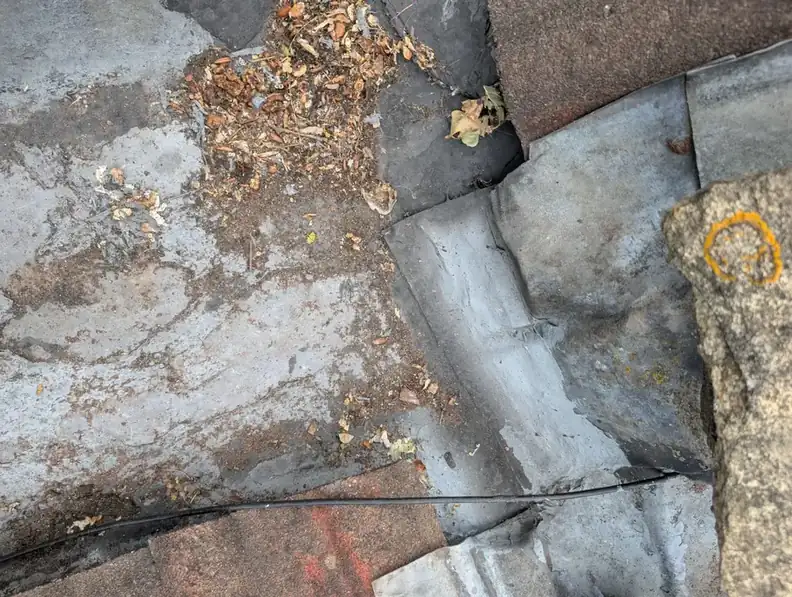
Valleys and back gutters get cleared of silt and leaves so we can see the lead. Half the time the lead underneath is sound and the blockage was the problem. The other half there is a split hiding under the muck.
Save It Or Replace It
Lead that has lifted but is not cracked can be re-dressed and re-fixed. Lead that is split, thinned or the wrong code comes out. We tell you which, and why, before you agree to anything.
Cut To The Right Code And Length
Flashings and soakers in Code 4, valleys in Code 5, in pieces no longer than 1.5 metres with laps between them so each piece can expand without tearing. That is the detail that makes new lead last fifty years instead of five.
Fix It Properly
Steps and aprons are turned into raked-out joints, wedged with lead, and pointed. Valleys are laid over new boards or underlay with the tiles cut back to leave a clear channel. Soakers go in under the slates course by course, not stuck on afterwards.
Patination Oil And Photos
New lead gets a coat of patination oil so it weathers evenly and does not streak white carbonate down your tiles. You get before and after photos and a written guarantee on the leadwork.
Lead Fitted So It Can Do Its Job
Lead fails when it is too thin, too long, or fixed so it cannot move. Get those three things right and it will outlast the tiles around it. Every piece of lead we fit is the correct code, cut to a sensible length with proper laps, and held with wedges and clips rather than hope. The leadwork carries a written workmanship guarantee that runs for ten years.
We will also tell you when lead is the wrong answer. A GRP valley trough on a 1990s estate house is a reasonable like-for-like replacement, and we will price it that way rather than selling you lead you do not need. And if the leak turns out to be the stack brickwork rather than the flashing, you hear that too.
Questions Worth Asking Before Anyone Touches Your Lead
What Code Is Going On?
Lead sheet comes in codes by thickness. Code 3 is thin roll for soakers at a push; Code 4 is the standard for flashings; Code 5 is for valleys and gutters that carry real water. A roofer who cannot tell you the code is either guessing or planning to use whatever is on the van. Thin lead in a valley wears through in a few years.
How Will It Be Held In?
The correct answer for a step flashing is: raked into the joint at least 25mm, lead-wedged, then pointed. For a valley: clipped at the laps, not nailed through the middle. If the answer involves adhesive, foam or a sealant gun, the lead will be loose again by the second winter.
Are They Cutting It Into Lengths?
A single run of lead the full length of a six-metre valley looks neat and will split. Lead has to be in pieces, lapped, so each one can expand and contract on its own. Ask how many pieces the valley will be in. If the answer is one, ask someone else.
Re-Dress The Old Lead, Fit New, Or Go GRP?
Not every leadwork call-out needs new lead. Here is how the three realistic routes compare for a typical Newcastle chimney or valley.
| Re-dress and re-fix existing lead | New lead | GRP valley trough | |
|---|---|---|---|
| Best when | Lead is sound and the right code but has lifted or lost its wedges | Lead is split, worn thin, the wrong code, or missing | Replacing an existing GRP valley, or where theft is a repeated problem |
| Guide cost | £180 - £450 | £350 - £1,200 depending on the amount of lead | £300 - £700 per valley |
| Expected life | The remaining life of the original lead, often decades | Fifty years or more fitted correctly | Twenty to thirty years |
| Looks right on an old house | Yes, it is the original | Yes, and weathers to match within a couple of years | No, grey plastic is obvious on a Victorian slate roof |
| Theft risk | Same as before | Some, on accessible terrace roofs; we fix it to make lifting it hard | None, nobody steals plastic |
| Where it goes wrong | If the lead was the wrong code all along | If fitted in long runs without laps, or with sealant instead of wedges | If laid on a roof with an uneven line, it ponds and leaks at the laps |
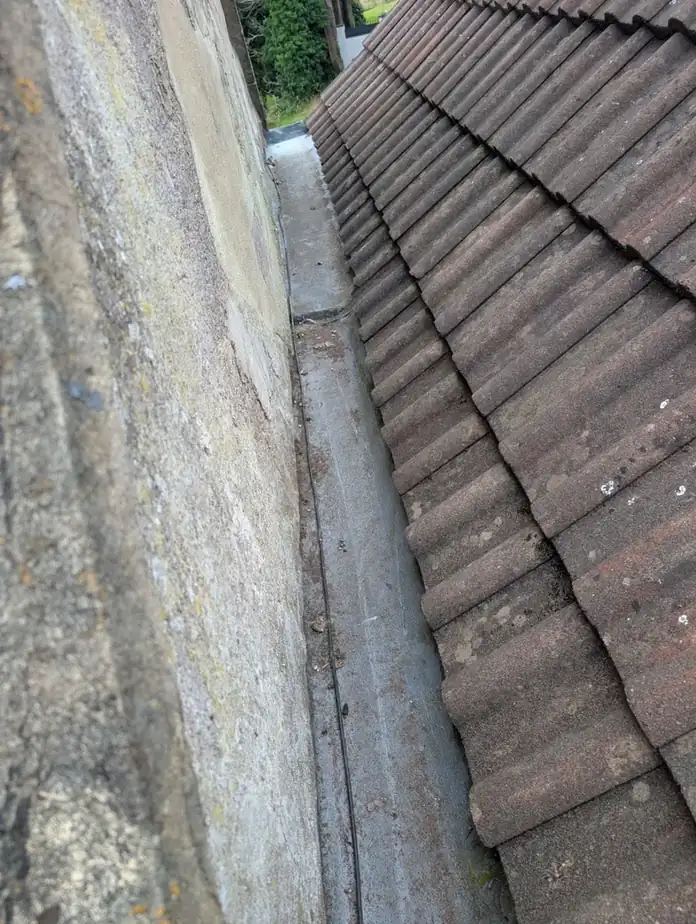
A Lead Gutter Doing Exactly What It Should
The photo is a lead abutment gutter between a tiled slope and a rendered wall on a job in Newcastle, after we had finished with it. Before, the old lead here was a single thin strip laid flat, nailed through the centre, and split in two places where it had been trying to expand for thirty years against the nails. Water came over the top in heavy rain and showed up as a stain in the corner of the room below.
The new lead is in lapped lengths, dressed up the wall under a cover flashing and down over the tiles, with nothing nailed through it. It is not glamorous and nobody will ever see it from the street, which is rather the point. If the stack above a gutter like this is also crumbling, that becomes a chimney repair at the same time and we would rather do both in one scaffold. And where the lead was the symptom but the slates around it had slipped, our slate and tile work covers that side.
We photograph every valley and flashing before and after. You see the split, you see the new lead, and the quote tells you which code went in.
About two in every five valley leaks we are called to in Newcastle turn out to be a blocked valley with sound lead underneath, and the fix is a clear-out rather than new lead.
Based on the enquiries and jobs handled by Huckleberry Roofing Ltd. A rough picture of what we see, not a formal survey.What Lead Flashing And Valley Work Costs Around Here
Re-wedging and re-dressing a run of step flashing, or clearing a valley and replacing one split section, sits at the lower end. New lead to a whole chimney, with apron, steps, soakers and back gutter, or a full valley in Code 5, sits at the top and usually wants scaffold. VAT included, and the figure is on paper before we start.
£180 - £1,200
See The Full Cost GuideLead And Valley Questions Answered Straight
Why did the sealant repair stop working after one winter?
What lead code should be used on a chimney?
Is a GRP valley as good as lead?
Our terrace keeps having lead stolen. What can you do?
Do I need planning permission to replace lead flashing or a valley?
What is patination oil and does it matter?
Lead Flashing & Valley Repairs Across Tyne And Wear
Newcastle upon Tyne is home turf, and we cover the rest of Tyne and Wear from there. Pick your area for the local page, or just ring if you are somewhere in between.
Get The Lead Fixed, Not Painted Over
If a flashing has lifted, a valley is leaking or the lead has gone altogether, ring us. We will find the failed piece, name it on the quote, and fit lead that will still be there when the tiles need doing.