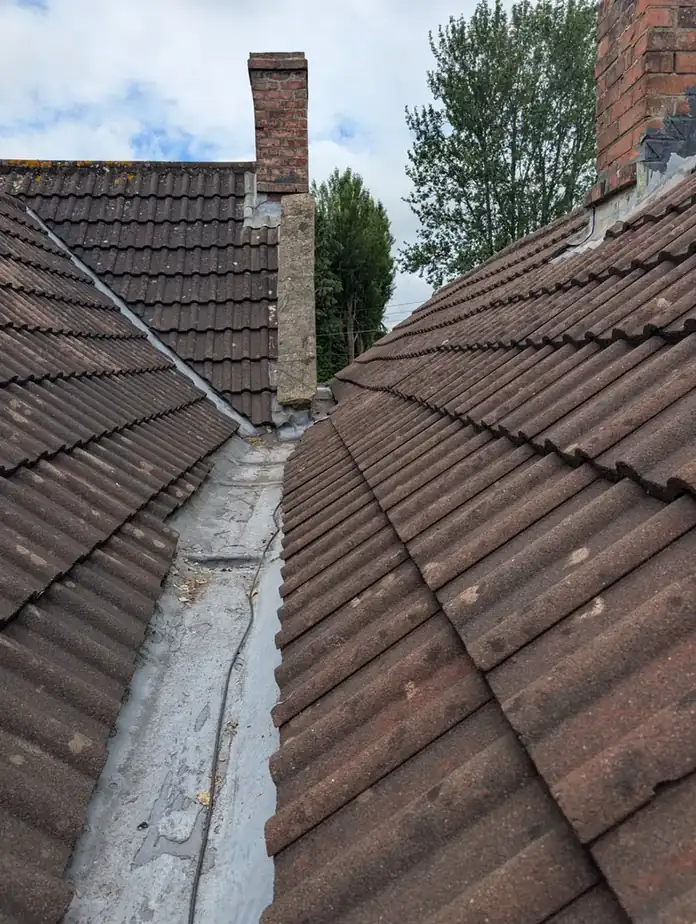
Chimney Repairs & Repointing In Newcastle
Is there a brick-coloured stain creeping down the bedroom chimney breast?
Repointing, re-flaunching, pots, cowls, flashings, partial rebuilds and capping or removal of disused stacks on homes across Newcastle upon Tyne and Tyne and Wear
A chimney is the one bit of your house that stands in the weather on all four sides with nothing sheltering it. On Tyneside that means decades of easterlies carrying rain, and on the coast, salt. The mortar goes first, then the flaunching on top, then the pot starts to rock. We repoint, rebuild, re-flash, cap or take down stacks, and we are used to the shared ones on terraces and Tyneside flats where your neighbour owns half of it. Free look, quote in writing.
- Lime or cement mortar to suit the brick, not whatever is in the van
- Lead flashings dressed to the stack, no cement fillets passed off as a fix
- Shared stacks on terraces and Tyneside flats quoted so both owners can see the split
- Written guarantee on the pointing and the lead
Get A Free Roof Inspection
Tell us what is going on and we will ring you back to arrange a look.
What Goes Wrong With Tyneside Chimneys
Most of the stacks we work on have not been touched since the fires beneath them were bricked up. Here is what fifty years of neglect in a North Sea wind looks like up close.
Mortar Joints Washed Out
Run a key along the joints of an old stack and it comes away as sand. Rain driven sideways across the Tyne does that to lime mortar in time and to weak cement mortar faster. Once the joints are open the brick faces spall, water gets into the core, and the stack starts to lean.
Flaunching Cracked Or Gone
The sloping mortar cap that holds the pots in place is the most exposed mortar on the house. It cracks, water sits in the cracks, frost opens them, and eventually the pot is sitting in a puddle on a loose crust. We find pots held on by habit alone.
Salt Eating The Coastal Stacks
In Tynemouth, Whitley Bay, South Shields and along to Roker the air carries salt, and salt crystallising inside brick and mortar breaks both apart from the inside. A stack three streets from the sea front will often need repointing twice as often as one in Fenham.
Flashing Pulling Away
Where the stack passes through the roof the lead should be let into a raked-out joint and wedged. Half the stacks we see have cement smeared over the junction instead. Cement cracks as the stack and roof move differently, and the gap it leaves is a direct route into the bedroom ceiling.
Pots Loose Or Cracked
A clay pot that has split will shed pieces onto the roof below and, in a gale, onto the street. Loose pots on a shared stack are a particular worry on a terrace because the slates they land on may not be yours. A rocking pot needs re-bedding or replacing before winter, not after.
Disused Flue Breeding Damp
A capped-off flue with no ventilation collects condensation and sweats into the chimney breast. The tell-tale is a tide mark on the plaster in the bedroom with no leak on the roof at all. The fix is a vented cap, not another coat of paint.
Our Routine On A Chimney Job
Chimney work is mostly about access and getting the mortar right. This is the order we do things in.
Look From Both Sides
Up the ladder for the outside, then into the loft to see where the stack passes through the roof. Staining on the rafters or the brickwork in the loft tells us whether the water is coming over the flashing or straight through the brick.
Sound The Brickwork
We tap and scrape. Soft joints, spalled faces and any lean get noted, and we check whether the top few courses are still bonded to the rest. That decides whether it is a repoint or a partial rebuild.
Who Owns It?
On a terrace or a Tyneside flat the stack often straddles the party wall. We photograph it and write the quote so each owner can see what is theirs. If the work affects the shared wall itself, the Party Wall etc. Act 1996 means your neighbour needs to be told.
Price It In Writing
You get a written quote naming the work: repoint, re-flaunch, new pot, new lead, rebuild from course so-and-so, or take it down. If scaffold is needed, that is on there too, not sprung on you later.
Do The Work
Joints raked out to a proper depth and repointed in a mortar that suits the brick. Flaunching stripped and recast. Lead cut, dressed, wedged and pointed. Rebuilds use matching reclaimed brick where we can get it so the stack does not look new from the street.
Clear Down And Guarantee
Rubble and old mortar come off the roof, the gutters below get checked for what fell in, and you get photos and a written guarantee for the pointing and the lead.
Pointing That Outlasts The Next Few Winters
Repointing is often done in a hurry with a cement mix that is far stronger than the old brick. It looks tidy for a year and then the brick faces blow off around it, because the mortar will not give and the brick has to. We match the mortar to the stack, rake out properly rather than smearing over the top, and the work carries a written workmanship guarantee that runs for ten years.
Where a stack is beyond pointing we say so. A top that is leaning or where the bricks lift out by hand needs taking down to sound brickwork and rebuilding, and no amount of mortar will change that. You get both prices, repoint and rebuild, with our view on which one is worth your money.
How To Spot A Roofer Who Should Not Be Near Your Chimney
They Want To Use Cement For Everything
Ask what mortar they intend to use. A Victorian stack in Heaton was built with lime, and hard cement pointing on soft old brick wrecks the brick. A 1960s stack in Longbenton can take a cement-based mix. If the answer is the same regardless of the house, they have not thought about it.
The Flashing Fix Is A Fillet
A cement fillet where lead should be is a leak in waiting. Lead flashings into a stack should be stepped into the brick joints on the sides, with a front apron and a back gutter behind. Anyone proposing to re-do the junction in mortar, or to smear a bitumen paint over the existing lead, is not fixing it.
Nobody Mentions The Neighbour
On a shared stack the Party Wall etc. Act 1996 applies to work on the wall it sits on, and a good roofer will raise that before the ladder goes up. A rebuild on one side of a shared stack without a word to the other owner is how disputes start, and you will be the one in it, not the roofer.
Repoint It, Rebuild The Top, Or Take It Down?
Three honest options for a tired stack. Which one is right depends on whether the flue is in use, how far the brickwork has gone, and whether you share it.
| Repoint and re-flaunch | Rebuild the top courses | Remove the stack | |
|---|---|---|---|
| Best when | Brick is sound, joints are open, pots are secure | Top of the stack is loose, leaning or frost-shattered | Flue is disused and the stack is more trouble than it is worth |
| Guide cost | £250 - £800 | £800 - £1,800 | £900 - £1,800 plus making good the roof |
| Scaffold needed | Sometimes, depending on height and pitch | Almost always | Always |
| Permissions | None for like-for-like | None unless listed or in a conservation area | Building Regs may apply if removed below the roofline; conservation areas can need planning consent |
| Neighbour involved | Only if the stack is shared | Usually on a terrace or Tyneside flat | Shared stacks cannot be removed without the other owner |
| Lifespan of the result | Fifteen years or more inland, less on the coast | Decades | Permanent, with the roof tiled over |
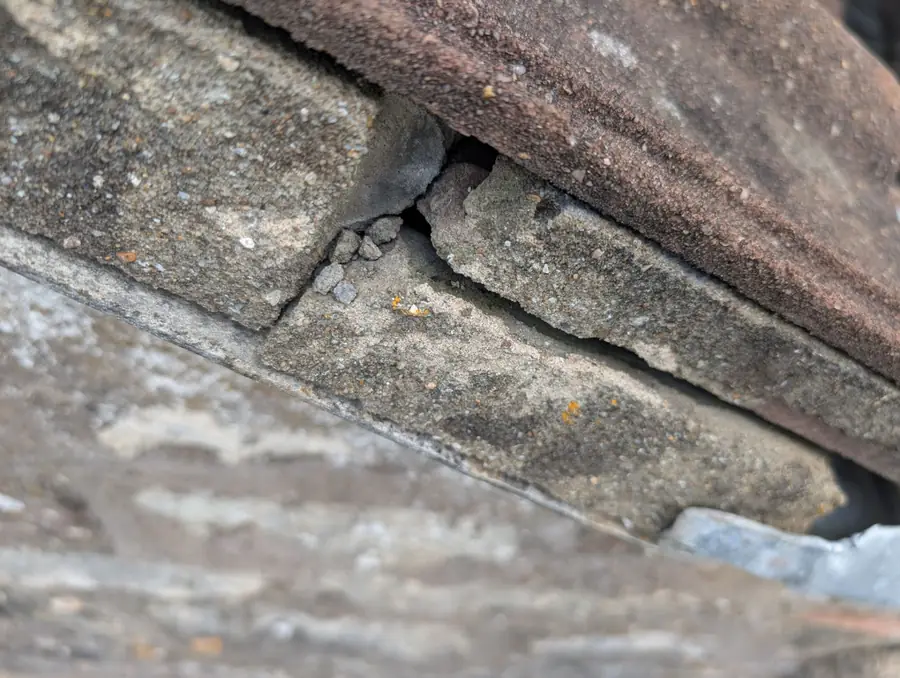
The Mortar Fillet That Was Doing Nothing
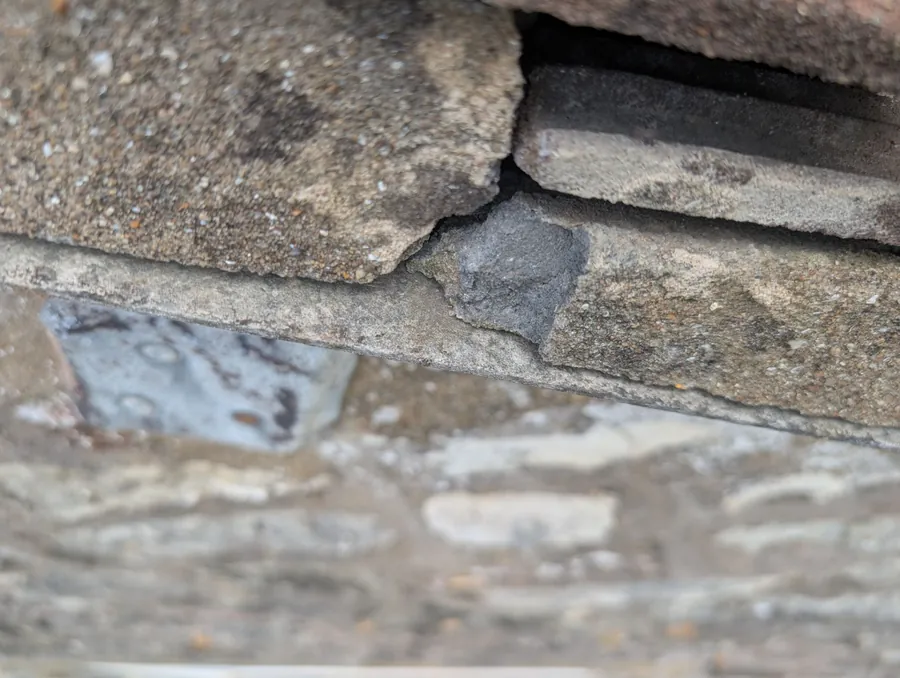
This is the junction between a tiled slope and a stone upstand on a Newcastle job, close up. Someone, at some point, had run a thick cement fillet along the join instead of fitting lead. You can see where it ended up: cracked clean through, pulled away from the stone, with loose lumps sitting in the gap. Every time it rained the water ran straight down behind it and out through the ceiling below.
We see the same thing on chimney stacks every week. Cement does not move with the building; lead does. Our lead flashing work covers the proper fix for junctions like this one, with the lead stepped into the joints and wedged. And if the water has been coming in for a while, the ceiling stain is often a long way from the stack, which is where our leak tracing comes in.
Either way, before we rake out a single joint you get photos of the fault so you can see why we are proposing what we are proposing.
Roughly half the chimney stacks we repoint in Newcastle have already been repointed once before in hard cement, and the brick faces have blown off around that pointing rather than the mortar wearing out.
Based on the enquiries and jobs handled by Huckleberry Roofing Ltd. A rough picture of what we see, not a formal survey.Chimney Repair Guide Prices
Repointing a modest stack from a ladder with a new flaunching and a pot re-bedded sits at the lower end. New lead all round, a rebuild of the top courses in matching brick, or taking a stack down and tiling over all need scaffold and sit at the top. VAT included, and nothing starts without the price in writing.
£250 - £1,800
See The Full Cost GuideChimney Questions We Hear A Lot
My chimney is shared with next door. Who pays?
Can you just take the chimney off? We do not use it.
Why does the stain on the chimney breast come and go?
Lime mortar or cement for repointing?
Do I need planning permission for chimney work?
How long will repointing last near the coast?
Chimney Repairs & Repointing Across Tyne And Wear
Newcastle upon Tyne is home turf, and we cover the rest of Tyne and Wear from there. Pick your area for the local page, or just ring if you are somewhere in between.
Sort The Stack Before The Pot Comes Down
A loose pot or a leaning top course does not wait for a convenient moment. Ring us, we will look at it from the ladder and the loft, and you will have a written price the same week.